

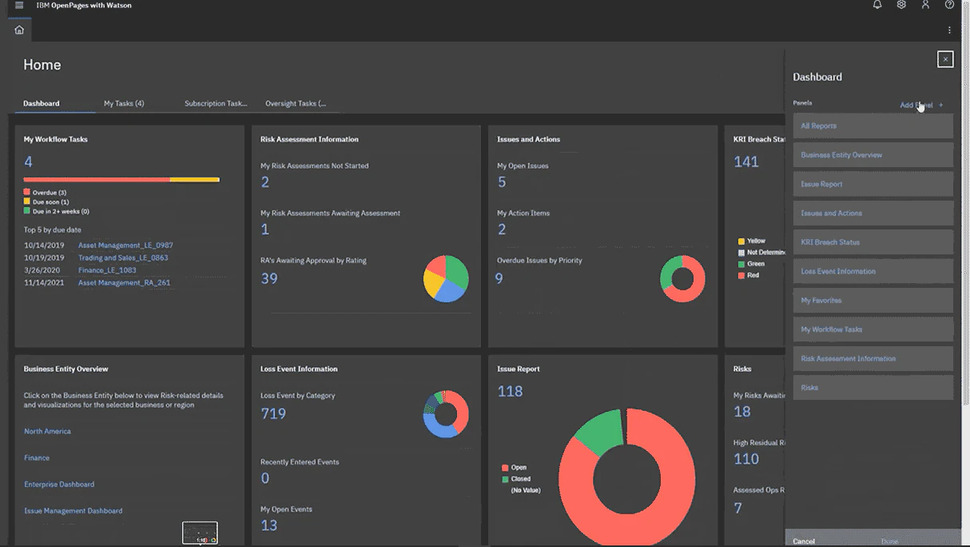
IBM OpenPages 9.1.3 represents a meaningful step forward in how organizations can visualize risk relationships and operationalize AI within GRC workflows. Rather than incremental UI tweaks, this release introduces two capabilities that materially change how risk, compliance, and control data can be explored, communicated, and automated: GRC Canvas and MCP-enabled AI integration.
Together, these features move OpenPages further away from static record management and toward a platform that supports interactive risk narratives and intelligent automation at scale.
The introduction of GRC Canvas fundamentally changes how teams interact with OpenPages data. Canvas allows users to visually model relationships across risks, controls, processes, issues, and other objects in a free-form, interactive workspace. Instead of relying solely on hierarchical views, reports, or object grids, teams can now build visual maps that reflect how risk actually flows through the organization.
Canvas is not just a diagramming layer. Objects on the canvas remain live, permission-aware OpenPages records. Users can group and color-code elements, annotate context, and navigate directly into underlying objects without breaking workflow. Versioning, draft and publish controls, and collaboration support make Canvas suitable not only for analysis, but also for executive communication, regulatory discussion, and internal challenge sessions. For operational risk, audit planning, and control design, this enables a much clearer articulation of dependencies, concentrations, and gaps that are often lost in tabular views.
Equally important in 9.1.3 is the expansion of AI integration through MCP (Model Context Protocol) support. By introducing a standardized MCP server for OpenPages, IBM has created a cleaner and more extensible way for AI agents to interact with GRC data such as issues, controls, and assessments. This goes beyond point features and opens the door to AI-driven workflows that can reason across OpenPages objects, handle complex field structures, and integrate with broader AI ecosystems.
Support for richer data types, multi-value enums, and structured JSON expressions significantly reduces friction when embedding AI into real-world GRC use cases. This enables scenarios such as automated issue summarization, control gap analysis, risk trend interpretation, and AI-assisted remediation planning — all grounded directly in OpenPages data rather than external exports or brittle integrations.
However, while these capabilities are powerful, they are not “plug and play” for most organizations. Both Canvas and MCP-enabled AI require intentional design, configuration, and governance to deliver value without introducing noise, inconsistency, or control risk.
This is where SureStep helps clients move from feature availability to operational impact.
For GRC Canvas, SureStep works with clients to define standardized visual patterns aligned to their risk taxonomy, regulatory obligations, and operating model. We design Canvas templates for use cases such as operational risk mapping, control coverage analysis, audit scoping, and regulatory walkthroughs, ensuring consistency across teams while preserving flexibility. We also align Canvas usage with OpenPages workflows, reporting, and permissions so visuals remain authoritative rather than illustrative.
On the AI side, SureStep supports clients in designing and governing MCP-based AI integrations within OpenPages. This includes defining safe and effective AI use cases, configuring data access and context boundaries, and integrating AI outputs into existing issue management, control testing, and remediation workflows. We help ensure that AI augments decision-making without undermining model risk management, auditability, or regulatory expectations.
Critically, SureStep approaches both Canvas and AI through the lens of enterprise GRC maturity. That means aligning these features to operating models, regulatory frameworks, and internal governance — not deploying them as isolated innovations. The result is faster adoption, clearer outcomes, and defensible implementations that stand up to internal and external scrutiny.
OpenPages 9.1.3 provides the tooling to visualize risk more clearly and apply AI more intelligently. SureStep helps ensure those tools are implemented with purpose, control, and measurable value.

























.webp)

-1.jpg)


.jpg)


.jpeg)


